Agentic Future of Control Hub
Defining the Future of Enterprise Administration in an Agentic World
My Role
Defined the AI governance strategy for Cisco Control Hub and aligned leadership around a vision for agentic administration.
-
Defined agentic administration vision
-
Led AI governance strategy
-
Facilitated leadership alignment workshops
-
Partnered with product and engineering on roadmap direction

The Business problem
Enterprise administrators spend significant time navigating fragmented management experiences while AI capabilities are emerging across the industry. The opportunity wasn’t simply to add AI—it was to rethink how administrators accomplish work while maintaining trust, governance, and enterprise control.
Strategic Framework

As AI capabilities matured, it became clear that administration would no longer happen exclusively inside Control Hub.
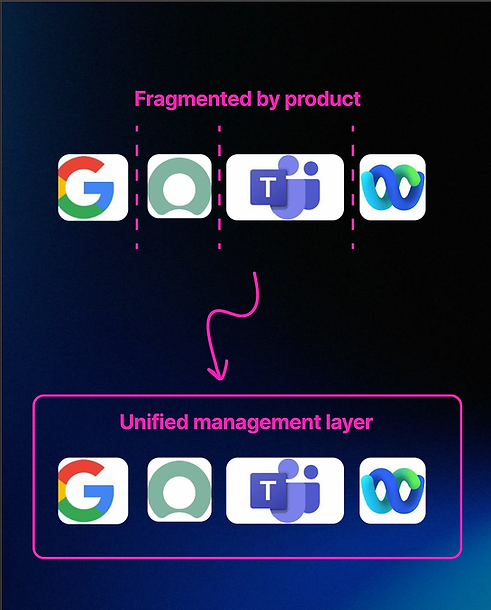
Historically, enterprise management has been tied to a single application. Administrators open Control Hub, navigate to a workflow, and complete a task. However, the rise of AI assistants, copilots, and agentic systems introduced a new challenge: management experiences were beginning to extend beyond traditional product boundaries.
To help guide Control Hub’s evolution, I developed a framework that organized our AI strategy into three complementary experience models: Embedded, Extended, and Hybrid.
Embedded
Extended
Extended experiences bring Control Hub capabilities into external AI platforms.
As AI assistants become part of everyday workflows, administrators increasingly expect to interact with enterprise systems from the tools they already use. Rather than requiring users to switch back into Control Hub, administrative capabilities can be surfaced through external agents, copilots, and AI-powered experiences.
This approach reduces context switching and allows management workflows to exist wherever users are already working.
Embedded experiences bring AI directly into Control Hub.
In this model, AI uses collaboration data, administrative context, and platform intelligence to help administrators understand their environment, troubleshoot issues, and complete tasks without leaving the product.
The goal is not simply to answer questions, but to help administrators make progress on their work through guided recommendations, planning, and action.
&
Enterprise AI requires more than intelligent recommendations—it requires trust. Every experience needed to respect security, administrative permissions, governance policies, and provide transparent, auditable actions with clear confidence levels.
The solution also had to fit within Control Hub’s existing architecture and support gradual organizational adoption, ensuring AI enhanced administrator workflows without disrupting them.
Enterprise Design Considerations
The future is not Embedded or Extended—it's both.
Hybrid experiences combine the strengths of each model, allowing administrators to move seamlessly between Control Hub and external AI systems while maintaining governance, trust, and visibility.
In this model, Control Hub remains the trusted management layer while AI-powered experiences extend administrative capabilities across multiple surfaces.
This framework became the foundation for discussions around agentic experiences, MCP integrations, governance models, and the future direction of AI-powered administration within Control Hub.
Embedded Strategy
Bringing the Vision to Life
To explore and communicate the future of AI-powered administration, our team created a working prototype that demonstrated how administrators could interact with embedded and agentic experiences.
Rather than focusing on a traditional chatbot, we explored how AI could understand administrative context, recommend actions, create plans, and safely execute work on behalf of users.
The prototype served as a vehicle for stakeholder discussions, design reviews, and strategy alignment, helping teams visualize how the Embedded, Extended, and Hybrid framework could come to life within real workflows.
My Role
Defined the strategic framework and future-state vision for agentic administration. Partnered with design, product management, and engineering to align stakeholders around future AI roadmap investments.
Team
Yankun Wang — AI UX Designer
-
Led design and implementation of the working prototype
-
Explored interaction patterns and agentic workflows
-
Brought the vision to life through a functional coded experience
Rachael Marr — AI Strategy Lead / AI UX Lead
-
Defined the strategic framework and future vision
-
Established experience principles and direction
-
Guided reviews and stakeholder alignment
Design Principles
These principles emerged from customer research, traditional usability testing, and conversations with administrators at in-person conferences and customer events. Together, they served as the foundation for exploring AI experiences that felt trustworthy, practical, and valuable in enterprise environments.

Human remains in control
AI recommends before acting.

Explainability
Every recommendation includes rationale.

Context over prompts
Use organizational data to reduce manual input.

Safe automation
Low-risk work can be automated while sensitive changes require approval.
Conceptual Agent Orchestration Model
A high-level model illustrating how enterprise AI transforms an administrator’s desired outcome into trusted, executable actions by combining reasoning, organizational context, and specialized skills while keeping humans in control.

Extended Strategy
Understanding a New Category of Software
Agentic applications introduce a fundamentally different governance challenge than traditional software.
Unlike conventional applications, agentic systems can evolve over time, gain new capabilities, access tools, and take actions on behalf of users. As these technologies emerged, we wanted to understand how enterprise administrators would evaluate, trust, and manage them.
To explore this space, we conducted research with enterprise administrators, collaboration engineers, and developers to identify the mental models, concerns, and governance needs that would shape future administrative experiences.
Administrators Need To Understand Capabilities, Not Technical Structures
Participants consistently struggled with technical concepts such as “tools” and schemas.
Administrators were less interested in implementation details and more interested in understanding:
-
What can this app do?
-
What systems can it access?
-
What actions can it perform?
This shifted our design approach away from technical terminology and toward capability-based explanations.
Trust Depends On Visibility Into Change
Unlike traditional applications, agentic systems can evolve after deployment.
Administrators wanted clear answers to questions such as:
-
What changed?
-
What new capabilities were added?
-
What risks am I accepting?
This led us to explore approval workflows and change-review experiences that surfaced meaningful differences over time.
Governance Must Scale Beyond Individual Users
Enterprise administrators rarely deploy capabilities one person at a time.
Participants expected:
-
Pilot groups
-
Staged rollouts
-
Bulk permissions
-
Organization-wide governance
This insight influenced how we approached rollout and access management experiences.
Ownership And Accountability Matter
In large organizations, administrators often need to understand who owns an application and who to contact when questions arise.
Participants wanted clear visibility into:
-
Ownership
-
Support contacts
-
Documentation
-
Approval responsibilities
This highlighted the importance of governance beyond technical configuration
Making Capabilities Understandable
Traditional application management focuses on permissions and technical configuration. Agentic applications introduce a new challenge: administrators need to understand what an application can actually do.
Research revealed that terms such as tools, schemas, and permissions often failed to communicate real-world impact. Administrators wanted a clearer understanding of capabilities, outcomes, and risk.
The resulting concepts focused on translating technical structures into understandable capabilities that could be reviewed and managed confidently.

Building Trust Through Change Visibility
Unlike traditional software, agentic systems can evolve over time.
Administrators consistently asked how they would know when capabilities changed and what risks those changes introduced. Rather than requiring administrators to rediscover changes themselves, we explored workflows that highlighted meaningful differences and supported informed approval decisions.

Designing Governance for Enterprise Scale
Enterprise administrators rarely manage access one user at a time.
Research highlighted the need for pilot groups, staged rollouts, and scalable governance controls that allowed organizations to validate new capabilities before broad deployment.
This work explored how agentic capabilities could be introduced safely while maintaining the flexibility organizations expect from modern administration platforms.

Why This Matters
Enterprise AI agents aren’t just another feature—they represent a new interaction model that fundamentally changes how administrators accomplish work. This project established principles for designing trustworthy, governable, and scalable agent experiences.
Embedded Strategy
Agentic Future
The Opportunity
As AI platforms evolved, a new challenge emerged.
Traditional applications are relatively predictable. Administrators understand what they do, how permissions work, and how to govern them.
Agentic applications introduce a different model. Capabilities can evolve over time, connect to external tools, and perform actions on behalf of users. This creates new questions around trust, governance, visibility, and control.
My Role
As AI Strategy Lead and UX Lead, I helped define how agentic applications should be governed within Control Hub.
My work included:
-
Defining governance and management strategy
-
Synthesizing research findings and customer feedback
-
Creating UX concepts and workflows
-
Designing administrative experiences
-
Partnering with Product Management and Engineering
-
Leading reviews and stakeholder alignment
This work explored how administrators could understand, trust, approve, manage, and audit evolving AI-powered applications and capabilities.
Bringing the Vision to Life
To make an abstract strategy tangible, I developed a high-fidelity prototype that demonstrated how the Embedded, Extended, and Hybrid framework could be applied to real administrative workflows. Rather than serving as a production-ready design, the prototype became a tool for stakeholder discussions, executive reviews, and cross-functional alignment around the future of enterprise AI administration.
Alignment
Aligned design, product, and engineering around a shared vision.
Facilitation
Facilitated roadmap and strategy discussions.
Validation
Validated interaction patterns through customer conversations and usability sessions.
Communication
Communicated complex AI concepts through realistic workflows.
Strategic Impact
These explorations helped shape Cisco’s long-term vision for enterprise AI administration, influencing roadmap discussions and establishing a shared framework for designing trustworthy agentic experiences.
-
Established a shared vision for trustworthy enterprise AI administration.
-
Influenced roadmap discussions across multiple AI and administrative initiatives.
-
Created a conceptual framework that aligned design, product, and engineering around agentic experiences.
-
Validated the vision through customer research, usability studies, and conversations at Cisco Live.
-
Helped define an emerging approach to enterprise AI administration by exploring how reasoning, orchestration, governance, and human oversight could work together.

Shaping the Future Together
Designing for AI isn’t a one-time effort. As the technology evolves, we'll continue to validate concepts with customers through usability studies, executive reviews, and conversations at Cisco Live. These discussions continue to challenge assumptions, surface new opportunities, and helped ensure the long-term vision remained grounded in real administrator needs.
The Future of Enterprise Administration